Description
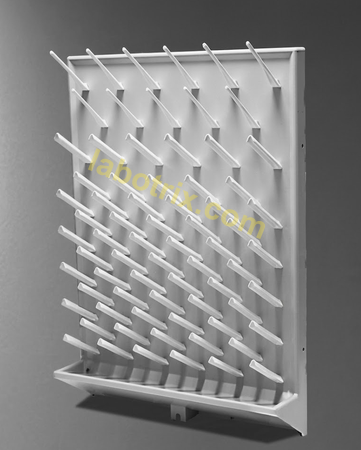
This wall-mounted drying board air-dries washed laboratory glassware — test tubes, flasks, measuring cylinders, burettes, funnels, beakers and other vessels — in the chemistry and biology rooms of general secondary schools and in the preparation room beside the sink. The vessels are placed upside down on the pegs, the water runs down into the tray by itself and air circulates inside the vessels. Drying takes place at room temperature, without heating and without a mains supply, which makes it the only acceptable method for volumetric glassware such as measuring flasks, cylinders, burettes and pipettes, because heating in a drying cabinet changes their capacity and accuracy.
The board is made as a wall panel of plastic with pegs of different lengths and has 32 seats in total: the peg pitch is calculated for test tubes and burettes, while wider vessels — flasks, cylinders and funnels — are hung across neighbouring pegs. The overall dimensions of the board are approximately 40 by 50 cm. A fixed plastic tray under the pegs collects the water and is sloped towards the drain spout so that water does not stagnate, the back panel protects the wall from moisture, and mounting lugs on the reverse of the base, which are an inseparable part of it, fasten the board to the wall above the sink. The board has no heating element and needs no electric power. The smooth plastic surface does not retain moisture and is easy to clean, and it may be wiped with a dry or slightly damp cloth. Operating conditions are an air temperature of +5 to +40 °C and a relative humidity of 40 to 60 % without condensation; storage is at +5 to +40 °C with a relative humidity of 60 %. The service life is 5 years and the warranty period is 12 months.
The set includes the drying board with holding pegs — 1 pc, a water collecting tray — 1 pc, the passport with the warranty card — 1 pc, and individual transport packaging — 1 pc. The mounting lugs for wall installation are an inseparable part of the base of the board.
Glassware is washed immediately after use with a brush of the appropriate size and a neutral detergent, rinsed several times under running water and then rinsed with distilled water, which removes the salts of tap water that leave a white deposit after drying. The vessel is then held over the board and placed on the pegs neck downwards: tall narrow-necked vessels such as measuring cylinders, burettes and flasks go on the long central pegs, low and wide items such as beakers, funnels and Petri dishes on the short pegs or between them, and small items such as glass rods and spatulas are laid in the gaps between the pegs. Heavy vessels are placed on the central pegs closer to the fixing point of the board, are lowered smoothly with both hands and are set one vessel to one peg without touching each other, and stacking in two tiers is not allowed. Once the glassware is completely dry it is taken off with one hand on the body of the vessel, supported from below, and put away in the cupboard.
Hot glassware taken straight from heating or from hot washing is not placed on the board, because the plastic deforms on contact with hot glass, and vessels with chips, cracks or sharp edges are rejected instead of being dried. Vessels with residues of aggressive reagents, concentrated acids or alkalis are rinsed before they are placed on the board, and the board itself is not used as a stand for spirit lamps, hotplates, heating appliances or heavy equipment. The board is installed and maintained by the teacher or the laboratory assistant, and students use it only under adult supervision; the product is intended for learning work in general secondary schools and the recommended age of students is from 10 years. At the end of each lesson the water is drained from the tray into the sink and the tray is wiped dry, and at the end of the working day the pegs and the base are wiped with a damp lint-free cloth. Once a month the whole board is washed with warm water, a neutral detergent and a soft sponge, with particular attention to the bases of the pegs and the corners of the tray; limescale is removed with hot water and citric acid or vinegar followed by thorough rinsing. Abrasive powders, metal brushes, organic solvents and concentrated acids are not used, the drain hole of the tray is kept clear, and the pegs and the wall fixing are checked regularly, since a loose fixing causes glassware to fall and water to stand in the tray.