Description
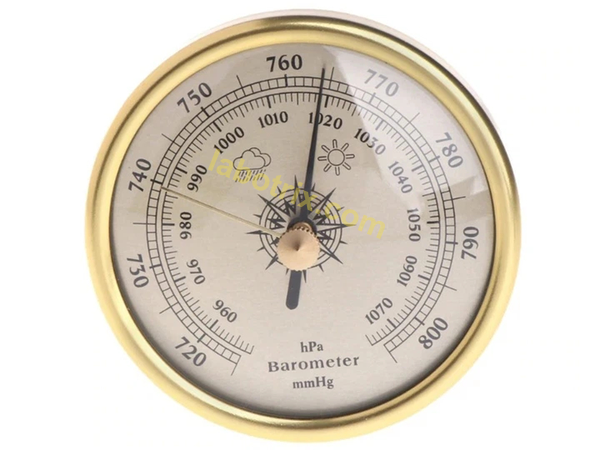
This aneroid barometer is intended for approximate observation of the fluctuations of atmospheric pressure and for measuring it. The instrument shows pressure in millimetres of mercury or in hectopascals. It is used in physics, geography and natural science lessons in general education institutions and in research laboratories for studying atmospheric phenomena and climatic patterns.
The sensing element of the instrument is an aneroid box, a sealed metal box with rarefied air. When atmospheric pressure changes, the box contracts or expands and transmits the deformation through a mechanical transmission mechanism to the indicating pointer on the dial. The instrument has two units of measurement, millimetres of mercury and hectopascals, and a single or double pointer depending on the version.
The measuring range is 940 to 1060 hectopascals. The measurement error is 5 hPa within the range of 990 to 1030 hPa and 10 hPa within the ranges of 940 to 990 hPa and 1030 to 1060 hPa, while the division value of the main scale depends on the design. The diameter of the instrument is 100 mm, and the divisions and figures of the scale are contrasting and convenient to read from a distance during a group demonstration. The barometer works autonomously and has no power source. Calibration is factory-set and performed by the manufacturer before shipment, and an adjusting screw on the rear wall is provided for adjusting the readings at the place of use. The operating temperature range is +5 to +40 degrees Celsius, and the conditions of use are the premises of an educational institution at relative humidity of 40 to 60 % without condensate. Marking and operating documentation are in Ukrainian, and the marking carries the trade mark, the model and a place for an inventory number. The service life is 5 years and the warranty period is 12 months.
The set includes the aneroid barometer with its dial and scales – 1 pc, a transparent plastic ring for mounting on a panel – 1 pc, a passport with a warranty card – 1 pc, and individual transport packaging – 1 pc. The instrument is supplied without additional accessories, a small nail is enough to mount it on a wall, and it needs no assembly before first use. It is hung on a wall at eye level or placed on a horizontal panel stand through the transparent plastic ring.
Readings are taken from the position of the black indicating pointer on the dial, consistently on one and the same scale, either millimetres of mercury or hectopascals. If the barometer has an additional control pointer that is turned by hand, it is aligned with the indicating pointer after each reading, so that at the next observation the difference between the positions of the pointers shows how much the atmospheric pressure has changed. For the study of atmospheric phenomena, readings are taken at the same times of day over several days or weeks and recorded with the date, the time and the value of the pressure. Adjustment and preparation are carried out by the teacher or the laboratory assistant, and students work with the instrument under supervision.
The barometer is protected from impacts, falls and strong vibration, which can damage the aneroid box, and from direct sunlight, sources of heat and magnets. The body and the plastic parts are wiped with a dry soft cloth, and the dial and the glass are wiped gently, without pressure; the instrument is not immersed in water or washed under running water, and solvents, alcohol, acetone, abrasive powders and metal brushes are not used. Once every three months the adjusting screw is checked by turning it in both directions to make sure it does not jam, and the glass and the dial are inspected for cracks and misting. The barometer is stored in a dry ventilated room at +5 to +40 degrees Celsius and relative humidity of 80 % without condensation, hanging on a nail or standing, and it is not laid flat side down on the bottom of a box, as that can deform the aneroid box.