Description
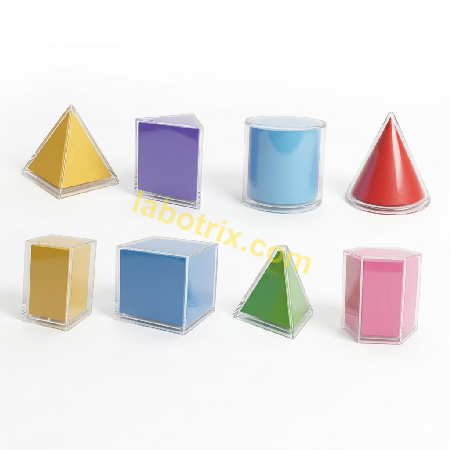
This demonstration set of three-dimensional models of geometric bodies is used in mathematics and geometry lessons in educational institutions. It develops the spatial imagination of students, shows the link between a solid figure and its flat net, and lets the class measure and calculate surface areas and volumes. The models suit frontal demonstration in front of the class, group work and individual tasks at the level of grades 5 to 11.
Every model is made of transparent impact-resistant non-brittle polymer material, and a coloured net of the same figure is mounted inside it. The net is made of flexible non-brittle material and folds along scored fold lines; it is visible through the transparent walls, and it can be taken out and spread flat on the desk to show how the surface of the body is built up. Transparency lets students see both the visible and the hidden edges and faces of a body from any angle. Models are 80 mm high depending on the version of the set. The shape of a body and the colour of the net inside it are distinguished from a distance of 5 metres, from the last desk in the classroom, while the fine detail of the net — fold lines and face captions — is examined close up with the model in hand. The colour print on the nets does not rub off during careful folding and unfolding.
The set includes eight geometric bodies — a cube, a rectangular parallelepiped, a triangular prism, a hexagonal prism, a quadrangular pyramid, a triangular pyramid, a cylinder and a cone — with a sphere and further bodies supplied depending on the version of the set; each body has its own coloured net fitted inside, and the set also includes a passport with a warranty card and individual transport packaging. The exact number and composition of the bodies follow the packing list. The set is supplied assembled, with the nets already placed inside the bodies, and needs no further assembly.
In work the model is turned in the hands and the body and its elements are named — faces, edges and vertices for polyhedra, bases, lateral surface and axis for bodies of revolution — and students count them through the transparent walls. The net is then released at the detachable joint of the model, taken out without excess force and unfolded on the desk along its fold lines. Students measure the faces of the net with a ruler, calculate the areas of the separate flat figures, add them up and compare the result with the surface area formula, recording which flat figures form the surface: squares for a cube, a rectangle and two circles for a cylinder. The net is then folded back along the same lines and placed into its own body, since a net from one model does not fit another.
The models need no power supply and work indoors in an educational institution at +5 to +40 °C and relative humidity of 40 to 60 % without condensation. Transparent walls are wiped with a soft lint-free cloth moistened in warm water with a neutral detergent and dried at once; the coloured net is cleaned with a dry cloth only. Alcohol, acetone, glass solvents and abrasive pastes cloud the transparency and damage the print, and heating or direct sunlight softens and deforms the polymer. Models are stored separately, without stacking one on another. Marking and operating documentation are in Ukrainian, the service life is 5 years and the warranty period is 12 months.