Description
The area units model is intended for proving and illustrating theorems on the areas of geometric figures in mathematics and geometry lessons. It builds the spatial imagination of students and forms an understanding of the concept of area, of the areas of the basic geometric figures and of the properties of area. The model is used as demonstration and practical material in grades 5 to 8 when studying the areas of polygons, solving problems and proving geometric theorems, in frontal, group and individual work.
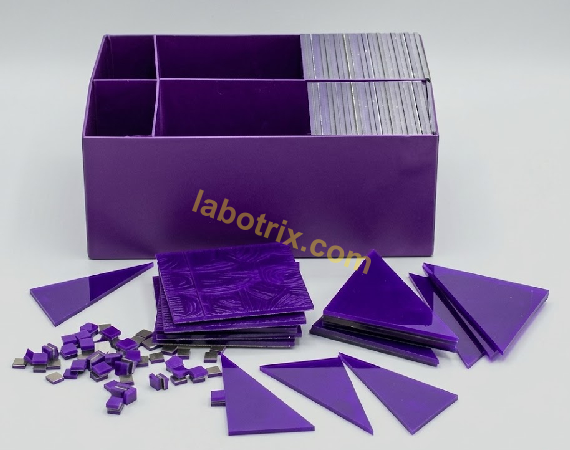
The model consists of a square working base with a side of 14.7 cm, ruled into a grid of unit squares, and a set of flat removable pieces of two main kinds — squares and triangles of different sizes. The pieces are made of hard impact-resistant plastic and all have the same thickness, so they lie side by side on the grid of the base, fit against one another without skew, can be traced round and rearranged during a proof. The pieces and the divisions on the base may carry colour coding or letter symbols for convenience in work, according to the packing list. The pieces work both on the base and on their own, for laying one on another and for tracing outlines on paper.
The set includes a square base with unit-square marking (side 14.7 cm), squares of different sizes, right-angled triangles, acute-angled triangles and obtuse-angled triangles, a box or tray with fixing for the pieces and the base, and a passport with an operating manual. The exact list of figures, their sizes and quantities are given in the packing list. The model is supplied ready for use and needs no special assembly or adjustment.
Work with the model rests on four classic techniques. In superposition one figure is laid on another, edge to edge and corner to corner, to establish whether they are equal or which area is larger. In tiling a figure is covered with unit squares without gaps or overlaps, or simply placed on the marked base and the cells under it are counted, so the number of squares gives the area in square units and the result does not depend on the order of laying. In composition and decomposition several pieces are joined into a new figure, or a figure is mentally divided into parts whose areas are already known and these areas are added, which gives the area of a complex figure through the areas of simple ones. In rearrangement different figures are built from the same set of parts without adding or removing any, so the area stays the same — and it is exactly this that underlies the proofs of the area formulas.
The model needs no power supply and works indoors in an educational institution at +5 to +40 °C and relative humidity of 40 to 60 % without condensation. Small pieces can reach the airways of young children, so the model is not left unattended in the presence of children under three years. Pieces are wiped with a dry soft cloth, microfibre being well suited; solvents, alcohol, acetone, abrasive powders and chlorine-based agents destroy the surface and rub off the marking, and moisture or heat deforms the pieces so that they stop fitting tightly. Figures from different sets or batches are not mixed, since their geometric parameters may differ and distort the results of laying and measuring. Marking and operating documentation are in Ukrainian, the service life is 5 years and the warranty period is 12 months.