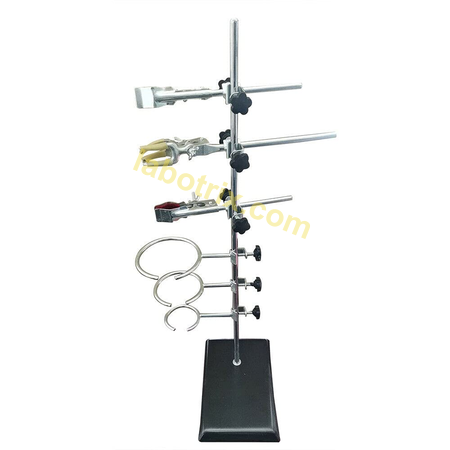
Description
This large laboratory stand fixes and holds glassware, instruments and assembly units in a set position during demonstration experiments, laboratory work and practical classes in the chemistry room of general secondary schools. Test tubes, flasks, funnels, condensers, burettes, gas outlet tubes and thermometers are mounted on it, and together with a spirit lamp and an asbestos gauze the stand forms the standard heating assembly used to study reactions, evaporate substances, distil liquids and prepare gases. It is also used in the natural science room.
The stand is a metal construction with a heavy base and a smooth vertical rod 600 mm long that is screwed into a threaded socket in the base. Holders — rings and clamps — are fitted to the rod by metal bossheads with clamping screws, so height and angle of rotation are adjusted steplessly by moving the bossheads along the rod, and each ring or clamp is carried by its own boss head independently of the others. The stand is supplied in two versions which differ in the composition of the set and in dimensions and are not interchangeable: the main version has a metal base of 210 by 135 mm and five bossheads, while the alternative version has a base of 195 by 138 mm made of iron with a protective coating and three cross bossheads. The stand needs no electric power and is assembled by hand without special tools, and it is suitable for work with a spirit lamp and an asbestos gauze. The metal surfaces may be wiped with a dry cloth without aggressive detergents. Operating conditions are an air temperature of +5 to +40 °C and a relative humidity of 40 to 60 % without condensation. The service life is 5 years and the warranty period is 12 months.
The main version includes the base 210 by 135 mm — 1 pc, the rod 600 mm — 1 pc, a large ring 110 mm in diameter — 1 pc, small rings 70 mm in diameter — 2 pcs, bossheads — 5 pcs, and clamps for flasks and beakers — 2 pcs. The alternative version includes the base 195 by 138 mm — 1 pc, the rod 600 mm — 1 pc, rings of different diameters — 3 pcs, cross bossheads — 3 pcs, clamps for beakers — 2 pcs, and a three-finger clamp — 1 pc. Each version is supplied with the passport and the warranty card — 1 pc, and individual transport packaging — 1 pc. The asbestos gauze and the spirit lamp are not part of the set and are purchased separately; when an assembly is put together, the actual composition of the delivered set is taken from the packing list.
The stand holds as long as the centre of gravity of the whole system passes inside the supporting area of the base, so the base is turned with its wider part towards the load and the load is placed over the base and never carried out to the opposite side. The heavier the vessel, the lower it is clamped on the rod: a flask with liquid and a condenser are fixed in the lower third, a funnel and a thermometer at the upper levels, and nothing is fastened at the very top, where a free length of rod is always left above the highest boss head. A test tube is clamped in its upper part near the opening and tilted at about 45 degrees with the opening turned away from the operator and the students; a flat-bottomed flask or a beaker is put on the asbestos gauze laid on a ring and only steadied at the neck by a clamp without pressure; a round-bottomed flask is clamped by the neck and supported from below by a ring with a gauze; a funnel is set in a ring of the matching diameter so that it stands vertically on the rim of its conical part; a condenser is clamped by its jacket with the receiving end sloping downwards; a burette is clamped strictly vertically in its upper part with the tap towards the operator and without deforming the thin-walled tube.
For heating, a boss head with a ring is fixed in the lower third of the rod, the asbestos gauze is laid on the ring with the asbestos layer upwards so that it lies flat and does not overhang the rim, the vessel is placed on the gauze, and the spirit lamp is set on the table under the ring, which is raised or lowered so that the bottom of the vessel is in the upper, hottest part of the flame. The flame must not reach the bossheads, clamps, rod or tubing, the spirit lamp is lit with a match and never from another spirit lamp, and it is extinguished only with its cap. Screws of the bossheads and clamps are tightened by hand to a noticeable resistance and never with pliers, spanners or levers, and the rod is screwed into the base by hand without skewing. After the experiment heating is stopped and the assembly is left to cool while still assembled, then dismantled in order — glassware first, then the holders, then the bossheads and finally the rod. The stand is wiped dry after every work with reagents, since drops of acids, alkalis and salt solutions destroy the coating and corrode the screw threads within a few days; the rod is kept clean and free of grease, because a clean dry rod is the condition for the boss head not to slip. The stand is not washed under running water or immersed in liquid, abrasive powders and metal brushes are not used, and an assembled set-up with glassware is never left unattended, particularly during heating. Work with the stand is organised and supervised by the teacher or the laboratory assistant.